

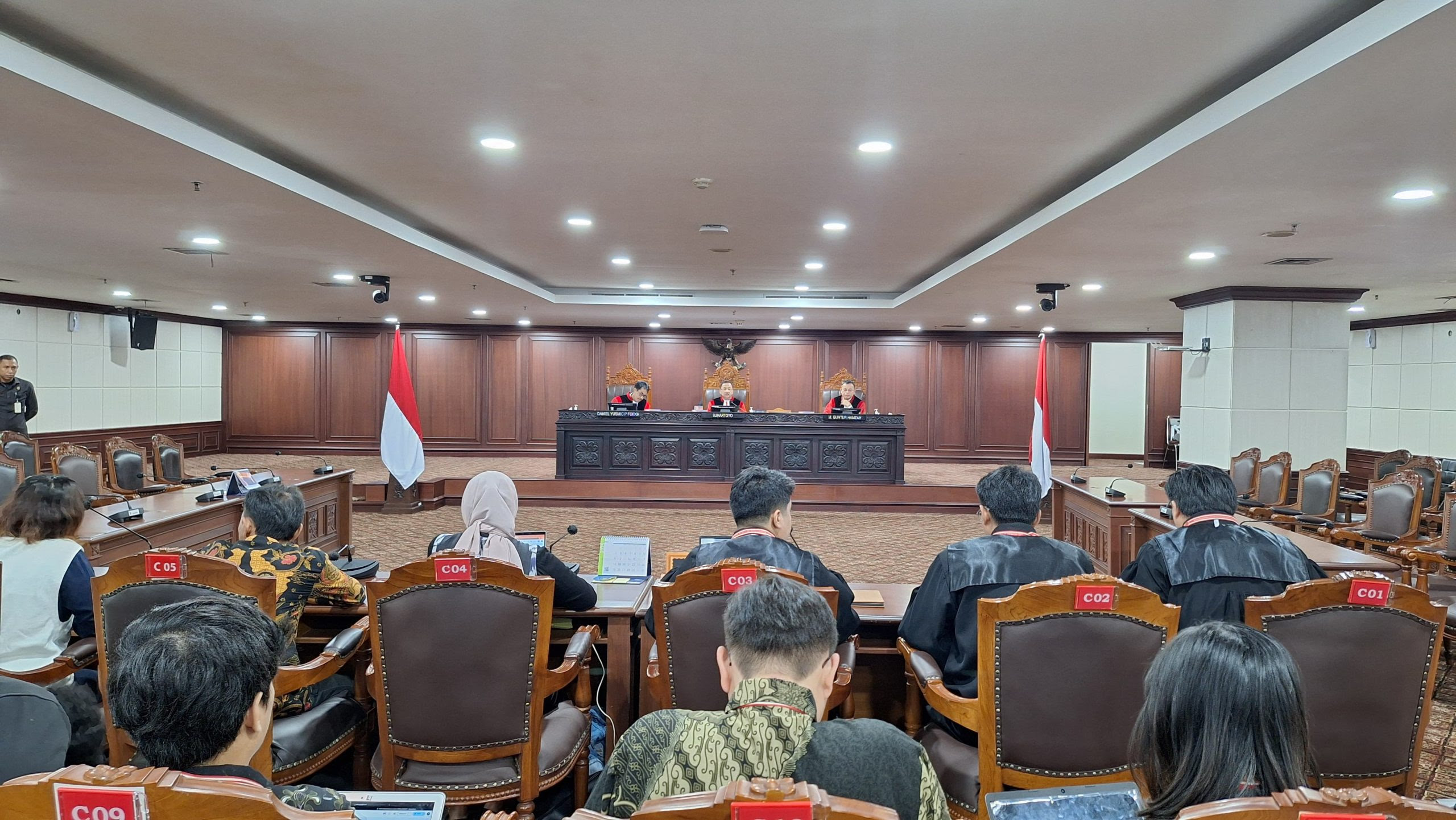
JAKARTA- Imparsial (The Indonesian Human Rights Monitor) together with civil society coalition attended the first panel session of the judicial review of Law Number 3 of 2025 concerning Amendments to Law Number 34 of 2004 concerning the Indonesian National Army (TNI Law), on Wednesday (14/05) at the Constitutional Court (MK). The petitioners of the judicial review called it a civil society coalition, consisting of three organizations active in advocating for human rights issues and security sector reform. The organizations are Imparsial, the Indonesian Legal Aid Foundation (YLBHI), and the Commission for Missing Persons and Victims of Violence (KontraS). Furthermore, three individual applicants are Indonesian citizens who are known to be vocal human rights activists, the daughter of the 4th President of the Republic of Indonesia Inayah Wahid, former KontraS coordinator Fatiah Maulidiyanty, and student activist Eva Nurcahyani.
The panel session was led by three MK judges, Suhartoyo, Daniel Yusmic Foekh, and Guntur Hamzah. In this first panel session, the applicant said that the planning of the revision of the TNI Law in the 2025 National Legislation Program (Prolegnas) was carried out illegally, thus contradicting Article 1 paragraph (2), Article 1 paragraph (3), Article 20, and Article 22A of the 1945 Constitution, as well as the Law on the Formation of Legislation (UU P3) and the House of Representatives Rules of Procedure. Furthermore, the revision of the TNI Law is not a carry over. Because the conditions that must be met to make a bill carry over are an agreement between the DPR, the president, and / or DPD to re-enter the bill into the list of medium-term prolegnas and / or annual priorities. Meanwhile, there is no TNI bill in the DPR Decree containing 12 carryover bills in Prolegnas 2025 or Prolegnas 2025-2029.
Then, the applicant also believes that the process of discussing the revision of the TNI Law deliberately closes public participation, is not transparent, and is not accountable, resulting in a failure of law formation. All documents on the formation of the revision of the TNI Law, starting from academic papers, problem inventory lists (DIM), to the law itself, cannot be accessed by the public. In fact, the applicant considered that there was a deliberate intention not to prioritize the principle of openness, where the draft TNI Bill that was being discussed by the DPR RI at that time was difficult to access. This emphasized procedural violations in the formation of laws and regulations. The applicant argues that the DPR and the President deliberately withheld the dissemination of the revised TNI Law document after it was passed and did not immediately open access to the document to the public. This is contrary to Article 88 and Article 90 paragraph (1) of P3 Law, which states that laws that have been passed must be disseminated by the legislator.
In their petition, the Plaintiffs request the MK to declare that the TNI Law on the Amendment to Law 34/2004 on the TNI does not fulfill the provisions of the formation of laws according to the 1945 Constitution, declare that the TNI Law has no binding legal force, and declare Law 34/2004 on the TNI to be re-enacted. Meanwhile, in their provision, the Plaintiffs requested the MK to declare that the TNI Law be postponed until the final decision of the Constitutional Court, as well as to order the President/DPR not to issue new implementing regulations or not to issue policies and/or strategic actions related to the implementation of the new TNI Law. The petition was filed because, according to the Petitioner, the implementation of the new law has already been carried out by the government and the TNI.
In closing, the three constitutional judges gave their suggestions and advice on the text of the demands submitted by the applicant. Suggestions for improvement were made with the aim that the demands of the applicants could be understood well by the other constitutional judges.


